Watching a child sleep and still feeling that flicker of worry is something every parent recognizes. Yaseen Academy’s teaching team hears this concern often from parents building their children’s Islamic foundation from home.
The strongest protection for a child in Islam is a parent’s sincere dua, rooted in the Quran and authentic Sunnah. Below are verified duas for child health and protection in Arabic, each with correct transliteration and translation.
Table of Contents:
1. Seeking Refuge for Your Child Through the Perfect Words of Allah
The Prophet ﷺ personally recited this exact dua over his own grandsons, making it the single most well-attested supplication for child protection in the Sunnah. He would place his hand on Al-Hasan and Al-Husain and say the words below, explicitly noting that Prophet Ibrahim used this same dua for Isma’il and Ishaq before him.
أَعُوذُ بِكَلِمَاتِ اللَّهِ التَّامَّةِ مِنْ كُلِّ شَيْطَانٍ وَهَامَّةٍ وَمِنْ كُلِّ عَيْنٍ لَامَّةٍ
A’udhu bikalimatillahi-t-tammati min kulli shaytanin wa hammatin wa min kulli ‘aynin lammah
“I seek refuge in the Perfect Words of Allah from every devil, every poisonous pest, and every harmful, envious eye.” (Sahih al-Bukhari 3371)
Note: “at-tammati” grammatically describes Allah’s Words as complete and flawless, meaning nothing can penetrate or override their protective power.
Parents frequently ask which single dua to prioritize when time is short. We always point them here first, since it carries the strongest chain of narration among all child-protection supplications and was practiced consistently by the Prophet ﷺ himself.
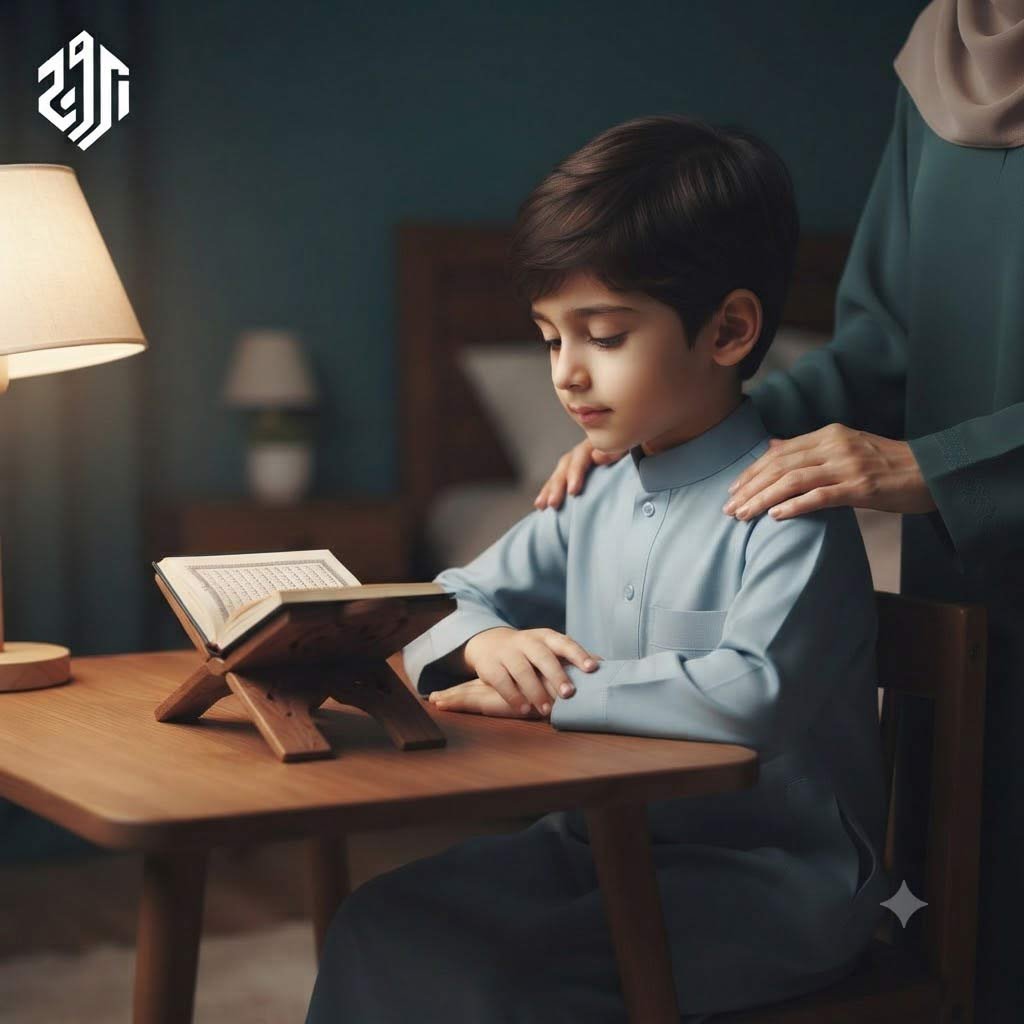
This dua is best recited while placing a hand gently on the child’s head or chest, once in the morning and once before sleep, though it can be repeated whenever a parent feels a pang of concern.
Reciting this dua with correct pronunciation matters, since mispronounced Arabic consonants can shift meaning entirely.
Parents unfamiliar with precise Arabic sounds often benefit from Yaseen Academy’s online Arabic classes or online Arabic classes for kids course, where learners learn to recite protective duas with accurate articulation from the very beginning.
Book your FREE Arabic trial online Arabic class at Yaseen

| Recitation Timing | Purpose | Recommended Frequency |
| Morning, after Fajr | Sets protective intention for the day | Once daily |
| Before sleep | Closes the day under Allah’s refuge | Once daily |
| During illness or unease | Immediate spiritual reinforcement | As needed |
2. Reciting Surah Al-Falaq for Protection From Unseen Harm
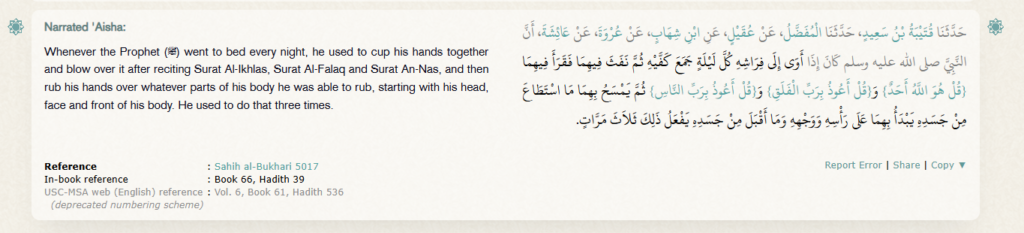
Surah Al-Falaq is one of two Quranic chapters, known collectively as Al-Mu’awwidhatayn, that the Prophet ﷺ recited into his cupped hands every single night before wiping them over his body.
Aisha (RA) reported that this nightly practice was so consistent it became a defining habit of his private worship, one Yaseen Academy encourages every parent to adopt for their household.
“قُلْ أَعُوذُ بِرَبِّ الْفَلَقِ مِنْ شَرِّ مَا خَلَقَ وَمِنْ شَرِّ غَاسِقٍ إِذَا وَقَبَ وَمِنْ شَرِّ النَّفَّاثَاتِ فِي الْعُقَدِ وَمِنْ شَرِّ حَاسِدٍ إِذَا حَسَدَ”
Qul a’udhu bi Rabbil-falaq, min sharri ma khalaq, wa min sharri ghasiqin idha waqab, wa min sharri an-naffathati fil-‘uqad, wa min sharri hasidin idha hasad
“Say, ‘I seek refuge in the Lord of daybreak, from the evil of that which He created, and from the evil of darkness when it settles, and from the evil of the blowers in knots, and from the evil of an envier when he envies.'” (Al-Falaq 113:1-5)
How Should a Parent Recite This Over a Sleeping Child?
The Sunnah method involves reciting Al-Falaq once, blowing gently into the palms, and passing them over the child’s head, face, and body, exactly as narrated in Sahih al-Bukhari 5017.
Most students in our programs find that pairing this physical gesture with the recitation makes the practice memorable for young children too. It transforms bedtime into a shared ritual rather than a solitary parental task.
We often remind parents that consistency outweighs perfect memorization in the early stages; a slightly hesitant recitation said nightly outweighs a flawless one said rarely.
Children who grow up witnessing this ritual tend to adopt it independently by age seven or eight, according to patterns our instructors observe across Yaseen Academy’s family-oriented cohorts.
Read also:Authentic Duas From Quran and Sunnah for Every Muslim
3. Completing the Child Protection With Surah An-Nas
An-Nas is the second half of Al-Mu’awwidhatayn and specifically addresses the whispering harm that originates from within, whether from jinn or from people, rather than the external dangers named in Al-Falaq. Together, the two surahs form what scholars describe as complete spiritual armor.
قُلْ أَعُوذُ بِرَبِّ النَّاسِ مَلِكِ النَّاسِ إِلَٰهِ النَّاسِ مِنْ شَرِّ الْوَسْوَاسِ الْخَنَّاسِ الَّذِي يُوَسْوِسُ فِي صُدُورِ النَّاسِ مِنَ الْجِنَّةِ وَالنَّاسِ
Qul a’udhu bi Rabbin-nas, Malikin-nas, Ilahin-nas, min sharril-waswasil-khannas, alladhi yuwaswisu fi sudurin-nas, minal-jinnati wan-nas
“Say, ‘I seek refuge in the Lord of mankind, the Sovereign of mankind, the God of mankind, from the evil of the retreating whisperer, who whispers in the breasts of mankind, from among the jinn and mankind.'” (An-Nas 114:1-6)
Many parents new to this practice ask why two separate surahs are needed instead of one. The answer lies in the distinct sources of harm each surah addresses.
Al-Falaq covers external threats like envy and dark forces; An-Nas covers internal whispers that can affect thoughts and behavior directly.
Understanding this distinction becomes far clearer once a child begins structured Quran study rather than casual memorization.
Yaseen Academy’s Online Quran Classes for Kids course introduces these two surahs early, precisely because of their daily protective role, alongside proper Tajweed so the meaning and rhythm are both preserved.
Help your child start learning the Quran with a FREE trial

Discover the Yaseen Academy Difference
Step into our virtual classrooms and see how our expert instructors make learning Quran and Arabic intuitive and clear. We focus on overcoming the specific hurdles non-native speakers face, building your confidence and connection with the Quran.
Excel in Your Quranic Studies
Join Yaseen Academy and master the Quran with our structured, professional curriculum.
Book Your Free TrialRead also: Dua Before Reading the Quran
4. Asking Allah for Righteous Offspring as Zakariyya Did
Protection is not only physical; it extends to a child’s character and faith. Prophet Zakariyya’s request in Surah Aal-Imran models exactly this kind of protective supplication, and the Quran explicitly confirms Allah accepted it soon after.
رَبِّ هَبْ لِي مِنْ لَدُنْكَ ذُرِّيَّةً طَيِّبَةً إِنَّكَ سَمِيعُ الدُّعَاءِ
Rabbi hab li min ladunka dhurriyyatan tayyibah, innaka Sami’ud-du’a
“My Lord, grant me from Yourself a good offspring. Indeed, You are the Hearer of supplication.” (Aal-Imran 3:38)
Why Does This Dua Specifically Mention “Righteous” Offspring?
The word tayyibah here means pure and wholesome, indicating Zakariyya wasn’t simply requesting a child but one whose character and faith would remain sound. This detail matters immensely for parents raising children in environments with competing values.
Before the Yaseen Method’s context-first approach to Quranic Arabic, many students memorized this dua as isolated sounds without grasping why “tayyibah” carries such specific weight. Once the vocabulary connects to lived meaning, students recite it with genuine understanding rather than rote repetition.
Zakariyya’s story is also a source of encouragement for parents facing delayed pregnancy or family struggles, since his prayer came after decades of waiting and was still granted.
Yaseen Academy’s Islamic Studies Classes for Kids course covers this narrative in depth, helping children connect Quranic stories to real emotional lessons.
The first session is free in Yaseen’s Islamic Studies Classes for Kids
5. Requesting That Your Child’s Prayer Life Stays Protected
Ibrahim’s dua in Surah Ibrahim asks for something many parents overlook when thinking about “protection,” specifically that a child’s connection to prayer remains intact throughout their life. This is arguably the deepest form of protection a parent can request.
رَبِّ اجْعَلْنِي مُقِيمَ الصَّلَاةِ وَمِنْ ذُرِّيَّتِي رَبَّنَا وَتَقَبَّلْ دُعَاءِ
Rabbi ij’alni muqimas-salati wa min dhurriyyati, Rabbana wa taqabbal du’a
“My Lord, make me an establisher of prayer, and [many] from my descendants. Our Lord, and accept my supplication.” (Ibrahim 14:40)
A common misunderstanding among new parents is treating protection as purely physical, guarding against illness, accidents, or the evil eye, while overlooking spiritual protection entirely. This dua corrects that imbalance directly.
In our experience, children raised hearing this dua recited by parents tend to internalize prayer as a family value rather than an isolated obligation.
Yaseen Academy’s Online Hifz Program pairs memorization goals with this exact kind of spiritual framing, so children understand why they memorize, not just what.
Start your child’s Hifz classes with a FREE session
6. Reciting the Prophetic Dua for Healing When a Child Is Sick
When illness strikes, the Prophet ﷺ had a specific practice: wiping the affected area with his right hand while reciting a direct plea for healing. Aisha narrated that he did this consistently for sick family members.
اللَّهُمَّ رَبَّ النَّاسِ أَذْهِبِ الْبَأْسَ اشْفِ أَنْتَ الشَّافِي لَا شِفَاءَ إِلَّا شِفَاؤُكَ شِفَاءً لَا يُغَادِرُ سَقَمًا
Allahumma Rabban-nas, adhhibil-ba’sa, ishfi Anta ash-Shafi, la shifa’a illa shifa’uka, shifa’an la yughadiru saqama
“O Allah, Lord of mankind, remove the affliction and grant healing, You are the Healer. There is no cure except Your cure, a healing that leaves behind no illness.” (Riyad as-Salihin 902)
This dua differs from the others on this list because it’s meant for active moments of sickness rather than general daily protection. The physical gesture, wiping with the right hand, is part of the Sunnah practice itself, not incidental.
Parents often ask whether reciting this dua replaces seeking medical treatment. It does not; scholars consistently affirm that dua and medical care work together, never as substitutes for one another. This dua accompanies treatment, offering spiritual comfort alongside physical care.
Read also:Dua for Sick Child in Arabic
Master These Duas With Yaseen Academy’s Expert Instructors
Teaching a child these seven duas correctly, with sound pronunciation and genuine understanding, builds a lifelong habit of turning to Allah for protection.
Yaseen Academy’s Ijazah-certified instructors and Al-Azhar University graduates bring 12+ years of experience teaching non-Arabic speaking families exactly this kind of foundational Islamic practice.
Through the Yaseen Method’s sound-before-rules approach, children learn to recite these protective duas with correct Tajweed from their very first lesson, not years later.
Every session is personalized to your child’s age and pace, with real-time correction from patient, qualified teachers.
Book a free trial lesson today and give your child a lasting foundation of protective dua, taught properly from the start.
Begin your transformation today by choosing the path that fits your goals:
- Online Arabic Classes (General & Comprehensive)
- Arabic Course for Beginners
- Arabic Alphabet Learning Course
- Online Arabic Classes for Kids
- Arabic Classes for Adults
- Arabic Grammar Course (Nahw & Sarf)
- Intermediate Arabic Course (B1/B2)
- Arabic Speaking Course (Conversational Fluency)
- Arabic Reading Course (Literary Excellence)
- Learn Arabic Writing Course (Calligraphy & Composition)
Ready to speak with confidence? Join the global community at Yaseen Academy and book your free placement interview today!
Discover the Yaseen Academy Difference
Step into our virtual classrooms and see how our expert instructors make learning Quran and Arabic intuitive and clear. We focus on overcoming the specific hurdles non-native speakers face, building your confidence and connection with the Quran.
Master the Arabic Language
Join our expert-led courses and build a strong foundation in Classical and Modern Arabic.
Get Your Free TrialRead also:How Dua Is Accepted in Islam
Conclusion
A child’s safety ultimately rests in Allah’s hands, and dua is the parent’s most direct way of reaching for that protection. These seven supplications, drawn from the Prophet’s own practice and the Quran itself, cover physical safety, spiritual character, and moments of illness alike.
What matters most isn’t memorizing all seven at once. It’s building a consistent habit, even starting with just one dua recited nightly, so protection becomes woven into your family’s daily rhythm rather than an occasional afterthought.
Frequently Asked Questions About Dua for Child Protection in Arabic
Can a Non-Arabic Speaking Parent Recite These Duas Correctly?
Yes, transliteration provides a strong starting point, though working toward proper Arabic pronunciation over time deepens both meaning and correct articulation. Structured lessons help parents and children progress from transliteration to confident Arabic recitation.
Is It Necessary to Recite These Duas in Arabic Specifically?
Reciting in Arabic follows the exact wording the Prophet ﷺ used, which scholars consider spiritually significant. Understanding the meaning in English alongside Arabic recitation is encouraged and does not diminish the dua’s validity.
How Young Can a Child Start Learning These Protective Duas?
Children as young as three or four can begin hearing these duas recited over them regularly, absorbing the rhythm before formal memorization begins. Active memorization typically becomes more effective once basic Arabic letter recognition develops.
Should These Duas Replace Practical Safety Measures for Children?
No, dua complements practical safety measures rather than replacing them entirely. Islamic teaching consistently emphasizes taking real-world precautions alongside sincere supplication to Allah.
What if a Parent Forgets the Exact Wording During a Stressful Moment?
Sincerity matters more than perfect recall in urgent moments; a simplified plea for Allah’s protection remains valid dua. Memorizing key phrases through repeated practice over time reduces this concern naturally.